A smaller model outperforming a much larger one makes an excellent headline. It was also the hook behind my LinkedIn post about the direction of model efficiency. The useful follow-up is less dramatic: outperforming it at what, under which settings, and inside what system?
Parameter count describes part of a model's structure. It is not a universal score for the usefulness of every answer. Training data, architecture, post-training, context, inference settings, and tools all influence the result. A narrow benchmark win cannot establish that one model is better for every workload.
Read the size label carefully
A dense model and a mixture-of-experts model do not necessarily use their parameters in the same way. An MoE model routes computation through a subset of experts, so the total parameter count and the active count describe different quantities.
For a concrete documented example, the Qwen3 release lists a 235-billion-parameter MoE model with 22 billion active parameters, and a 30-billion-parameter model with three billion active. Those labels help explain architecture; they do not mean only the active parameters exist in the deployment's storage or memory plan.
The practical questions remain: which artifact is loaded, how is it represented, what hardware serves it, and how much context and concurrency are required? Quantization changes the representation, while expert routing changes which parts participate in computation. They are different mechanisms.
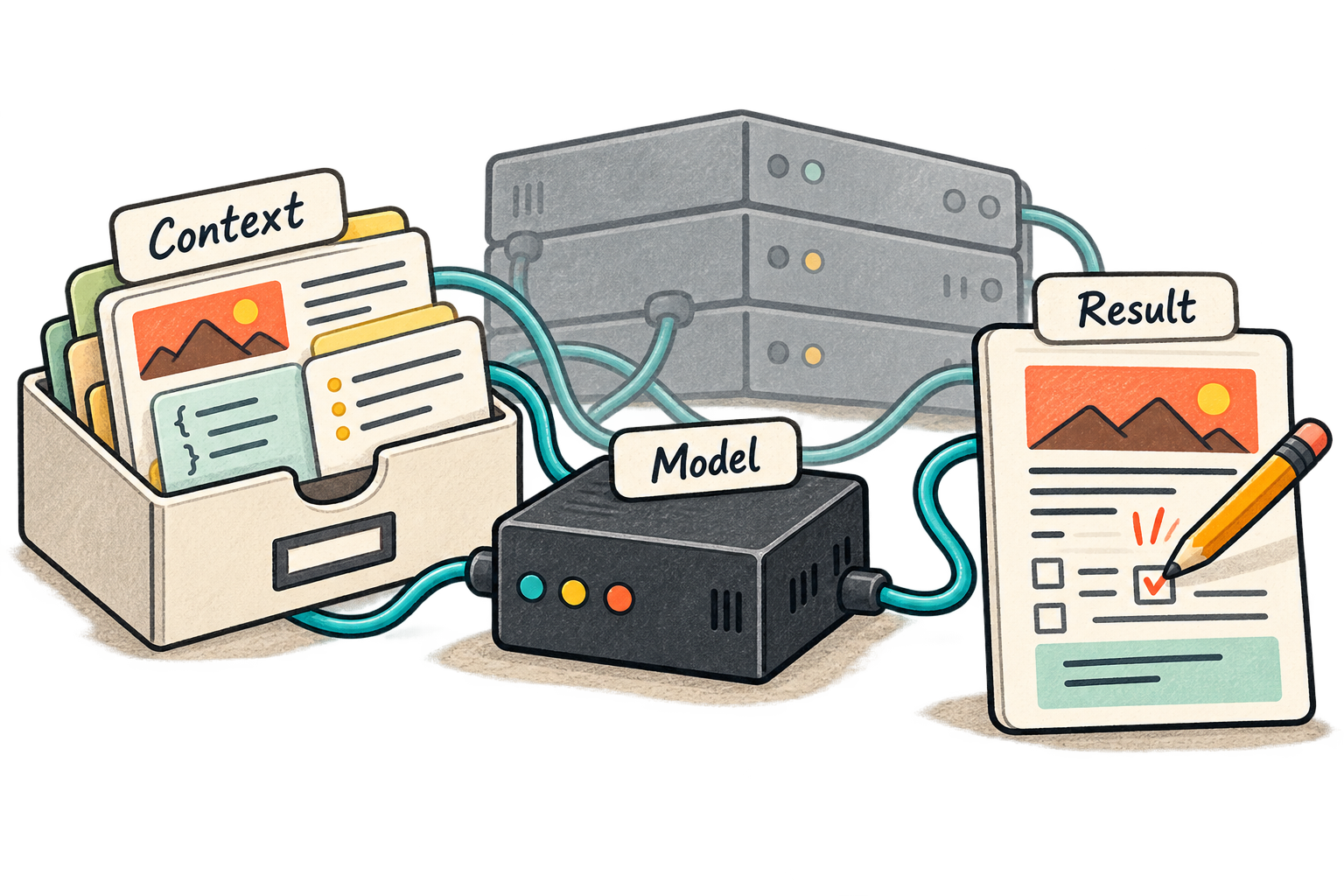
- Useful context
Retrieve the right facts and preserve their source and permissions.
- Suitable model
Choose capability that meets the task's measured requirements.
- Checked result
Validate structure, evidence, and the requested outcome.
A stronger component cannot automatically repair missing facts or an incorrect definition of success.
Give the model a solvable problem
Imagine a documentation assistant answering a question about a private API. A large model with no access to the current documentation may give a plausible but outdated answer. A smaller model supplied with the exact current endpoint description may have an easier task.
That is a worked example, not evidence that retrieval makes every smaller model superior. Retrieval can also fail. It may choose the wrong version, omit a crucial exception, or expose documents the user should not see. The system should carry document identifiers and versions alongside retrieved text so an answer can be checked against its evidence.
A sensible output contract might require the endpoint, required fields, a source link, and an explicit “not found” result when the documentation lacks the answer. This narrows the task from broad recollection to grounded explanation. It also gives the evaluator something more precise to inspect than whether the prose sounds confident.
Separate model improvements from system improvements
Run one experiment at a time. First compare candidate models with the same context and output requirements. Then compare retrieval strategies with the chosen model fixed. Finally evaluate the complete workflow under realistic traffic.
If both the model and retrieval change simultaneously, a better score will not tell you which change helped. If the combined result is all you need for a deployment decision, that can still be useful—but record that it is a system comparison.
| Change | What to hold constant |
|---|---|
| Swap the model | Inputs, context, output contract, and evaluation cases |
| Improve retrieval | Model version, prompt structure, and grading rules |
| Reduce precision | Model revision, runtime conditions, and workload |
| Add a fallback | Compare total success, latency, and cost across the whole path |
Count the cases where smaller is not enough
Some tasks need broader knowledge, more difficult reasoning, or stronger performance on unfamiliar inputs. A narrow evaluation set can hide that boundary. Include long documents, conflicting evidence, ambiguous requests, and questions outside the product's supported scope.
A failed result may call for better context, a stronger model, a deterministic tool, or a human decision. Do not treat every failure as a reason to enlarge the model, but do not turn model minimalism into a rule either. The job is to meet the requirement reliably.
Track failures by type. Wrong retrieval is different from ignoring correct evidence. Invalid JSON is different from valid JSON containing false values. These distinctions make the next experiment obvious instead of encouraging random prompt edits.
Optimize what you can keep operating
Smaller models can reduce resource requirements in some deployments, but the final benefit depends on serving efficiency and workload. A complicated router, several retrieval calls, and a fallback attempt can erase an apparently attractive saving. Measure the whole request and the human work needed to repair it.
For the documentation example, I would begin with a small set of known questions, versioned sources, and a straightforward answer validator. Establish a reliable baseline, then try less expensive candidates. Preserve difficult examples as regression cases.
The interesting trend is not simply “small beats large.” It is that careful task design and better components give engineers more options. The useful choice is the system that meets its promises within the resources you can sustain.
Adapted from my original LinkedIn post .
Share